
Factoring Flow Chart
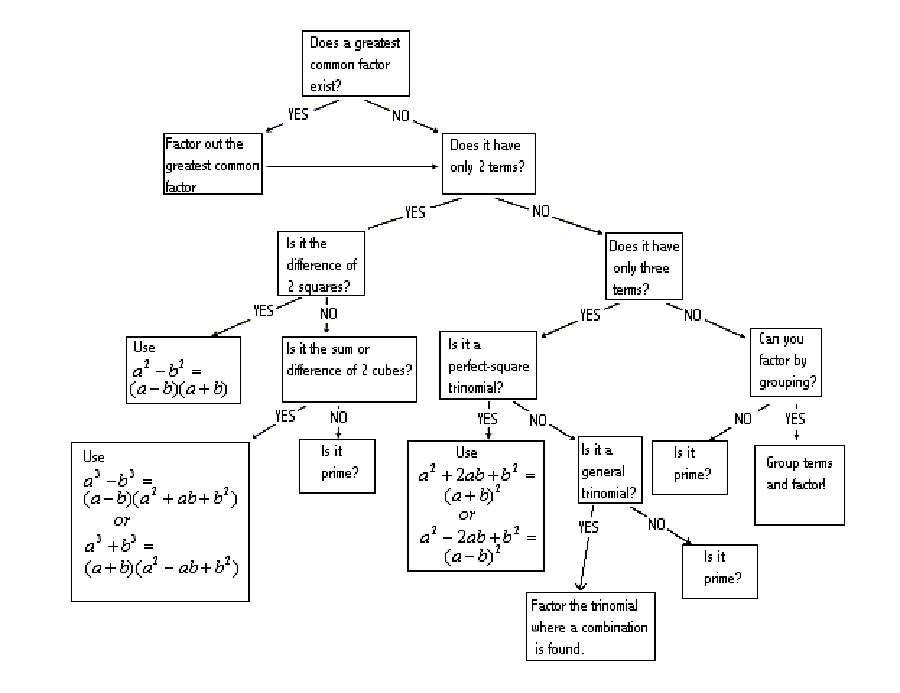
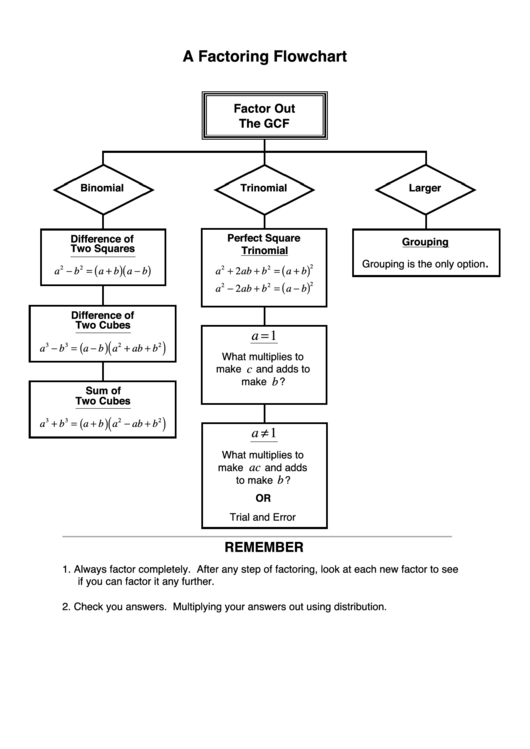
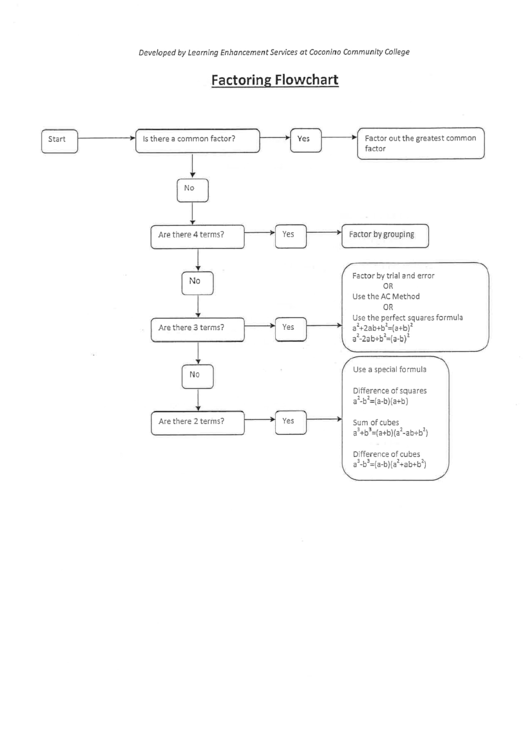
Factoring Flow Chart - Split bx term into sum of those two numbers. This process includes identifying common factors, using the distributive property, and recognizing perfect squares. 3) look for matching parenthesis. Group first two terms and last two terms (reverse distribute). Factor out binomial difference of grouping grouping is the only option. Find two factors of ac that add or subtract to b. 3 + 64 = ( 3 + 1 = (5 + 4)( 2− 4 + 1)(25 2− 5. Is it a sum of cubes? Write the factored expression \((x+p)(x+q)\). Today i'm sharing a factoring flow chart that has been really helpful to my students. Factoring a trinomial with leading coefficient 1. To do this, use opposite operations to move each term on the right side to the left side. Web tie together everything you learned about quadratic factorization in order to factor various quadratic expressions of any form. Split bx term into sum of those two numbers. Multiplying your answers out using distribution. ( 2 a − b )( a + ab +. + bx + c ? How many terms are there? Today i'm sharing a factoring flow chart that has been really helpful to my students. Factor out the greatest common factor (gcf): 3 3 a + b 2 + + 9) +. Factor by grouping, usually 2 by 2, sometimes 3 by 1. Web before trying to factor, you need to put the equation in the standard form: Complex factoring problems can be solved using the chart as a general guide and applying the techniques that will be discussed below. = )( + ) examples: ( 2 a − b )( a + ab +. Web tie together everything you learned about quadratic factorization in order to factor various quadratic expressions of any form. Is there a common factor? + bx + c ? Then factor the gcf out of each group. Group in groups of two terms ex: 2 xx− 4 xx− 21 = (xx− 2. Write the factored expression \((x+p)(x+q)\). We believe you'll like ittry it now and you'll seeas easy as it is free Complex factoring problems can be solved using the chart as a general guide and
applying the techniques that will be discussed below. Find two factors of ac that add or subtract to b. This flowchart process assumes the polynomial to be factorable. 10 xx + 11 xx + 3 = (2 xx +. 3) look for matching parenthesis. Find two factors of ac that add or subtract to b. As depicted in figure 1, the proposed approach is started by reading the known power system parameters, candidate lines and units, frequency data, uncertainty information, electricity market data, and economic data. To do this, use opposite operations to move each term on the right side to the left side.. Is there a common factor? What is the value of in a. Web the flow chart on the first page gives you a quick reference on approaching a factoring
problem. Multiplying your answers out using distribution. Web a factoring flowchart the gcf 2 a remember 1. Is it a difference of squares? 2) 1) first, group by 2’s. 2 are in your polynomial? As depicted in figure 1, the proposed approach is started by reading the known power system parameters, candidate lines and units, frequency data, uncertainty information, electricity market data, and economic data. Then factor the gcf out of each group. We believe you'll like ittry it now and you'll seeas easy as it is free After any step of factoring, look at each new factor to see if you can factor it any further. As with any concept, the way to get good
at factoring is to practice it a lot. From taking out common factors to using special products,. Web a factoring flow chart is a visual representation that outlines the sequential steps involved in the factoring process. 10 xx + 11 xx + 3 = (2 xx +. 4.5/5 (12k reviews) This process includes identifying common factors, using the distributive property, and recognizing perfect squares. ) is it a difference of cubes? 2 2 + 6 = 2 ( + 3) start here! If you have two terms: Web the flow chart on the first page gives you a quick reference on approaching a factoring
problem. Is it a difference of squares? − 21 = ሺ − 7ሻሺ + 3ሻ − 3 = ሺ2 − 1 ሻሺ5 + 3ሻ. Which special type is it? What is the value of in a. If you find none of these methods apply, write. 2− 25 = ( − 5)( 9 2− 64 = (3 − 8)(3. Web let's get equipped with a variety of key strategies for breaking down higher degree polynomials. 4.5/5 (12k reviews) ( )( ) ( )( ) ( )( ) ( )( ) ( )( ) ( )( ) ( )( ) ( )( ) factoring flow chart for: ( 2 a − b )( a + ab +. Write the factored expression \((x+p)(x+q)\). Is there a common factor? We have a trinomial with leading coefficient \(1\), \(b=2\), and \(c=−15\). How many terms do you have? How many terms are there? You must always try to factor out the gcf first. This flowchart process assumes the polynomial to be factorable. = )( + ) examples: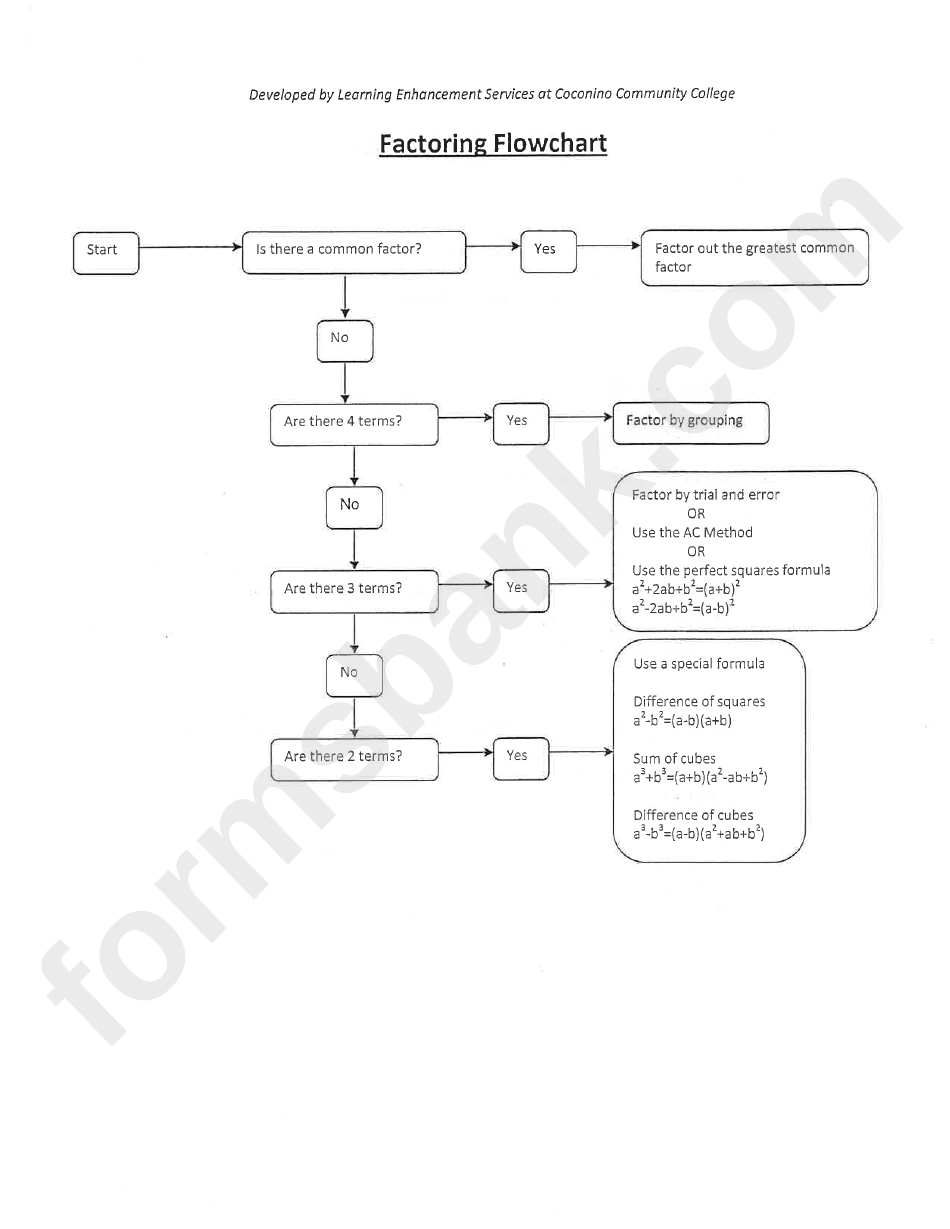
Factoring Flowchart printable pdf download
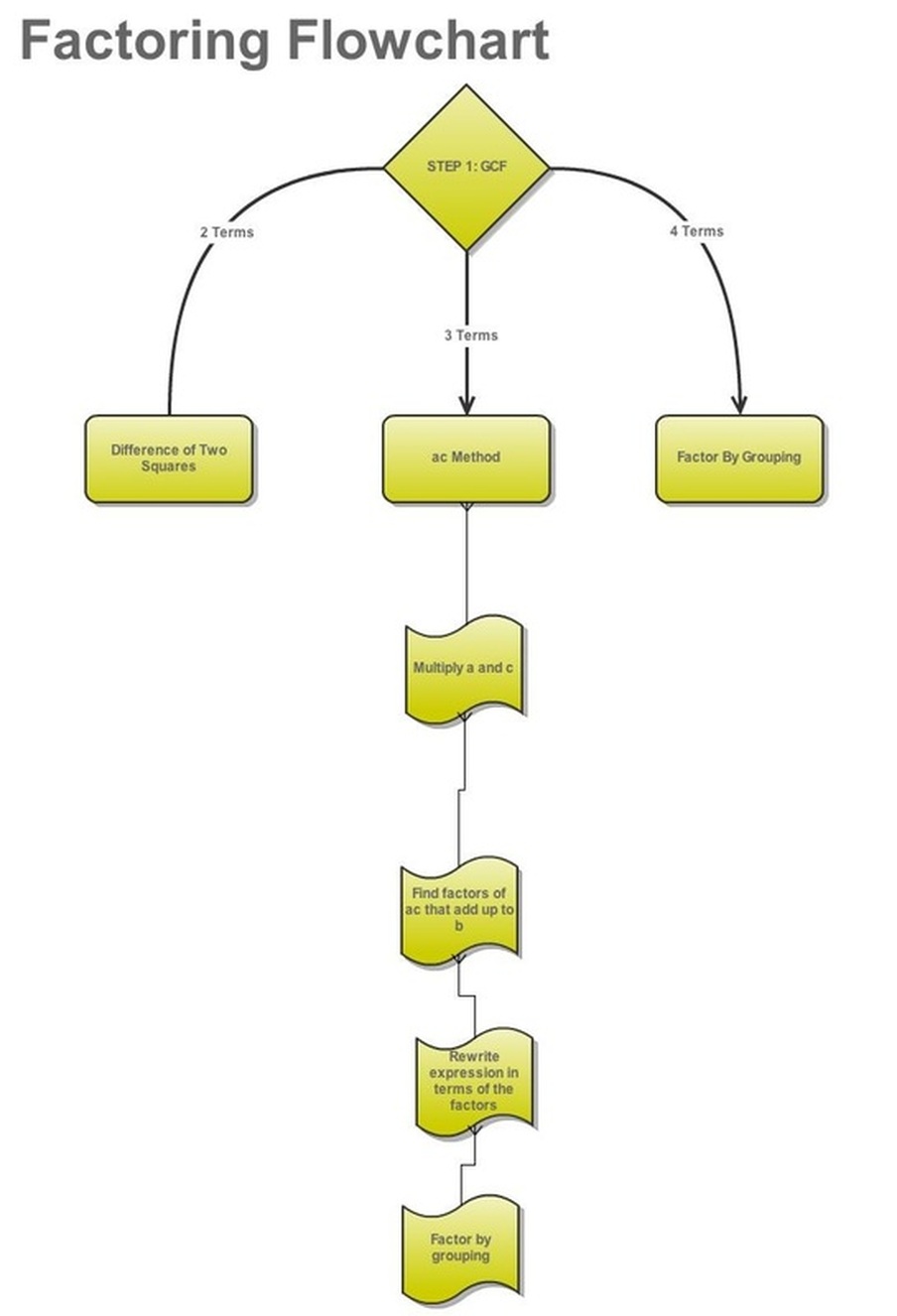
Factoring Flow Chart A Visual Reference of Charts Chart Master

Factoring Quadratic Trinomials *Flowchart* Graphic Organizer
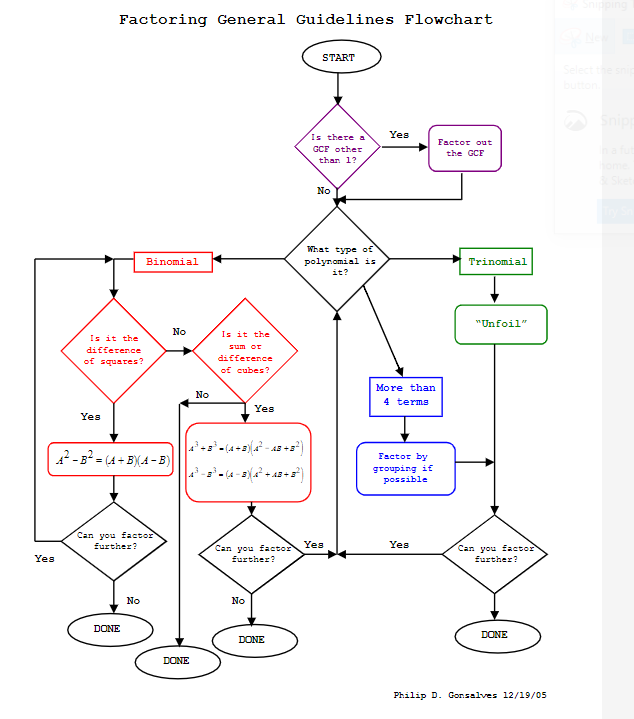
Factoring Flow Chart Math = Love
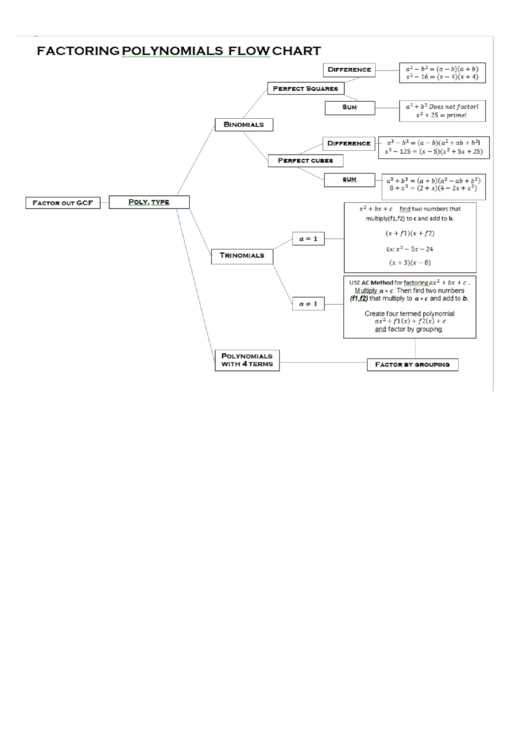
Top 5 Factoring Flow Charts free to download in PDF format
Factoring Flowchart
A Factoring Flowchart printable pdf download
Top 5 Factoring Flow Charts free to download in PDF format
Factoring Flow Chart Math = Love
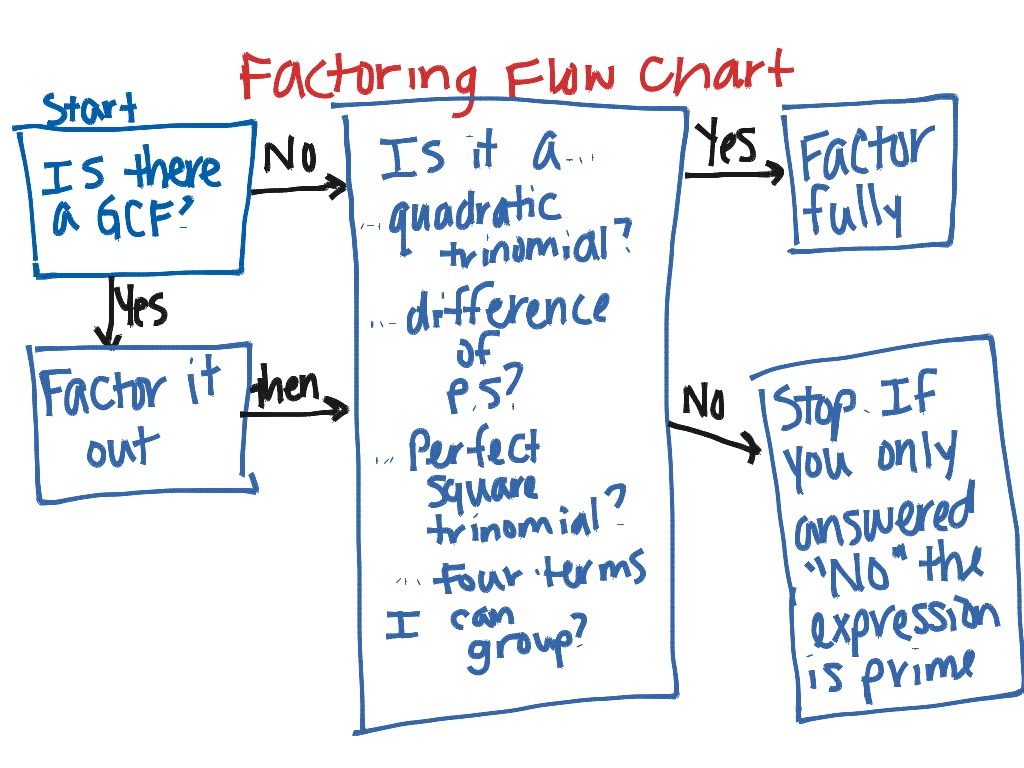
Factoring Flow Chart A Visual Reference of Charts Chart Master
Factor Out Binomial Difference Of Grouping Grouping Is The Only Option.
2 − 4 10 2 − 11.
Web A Factoring Flowchart The Gcf 2 A Remember 1.
) Is It A Difference Of Cubes?
Related Post: